
Building the National Single Payer Movement in the Bay Area
Updates on National Single Payer and Students for a National Health Program (SNaHP) at UCSF

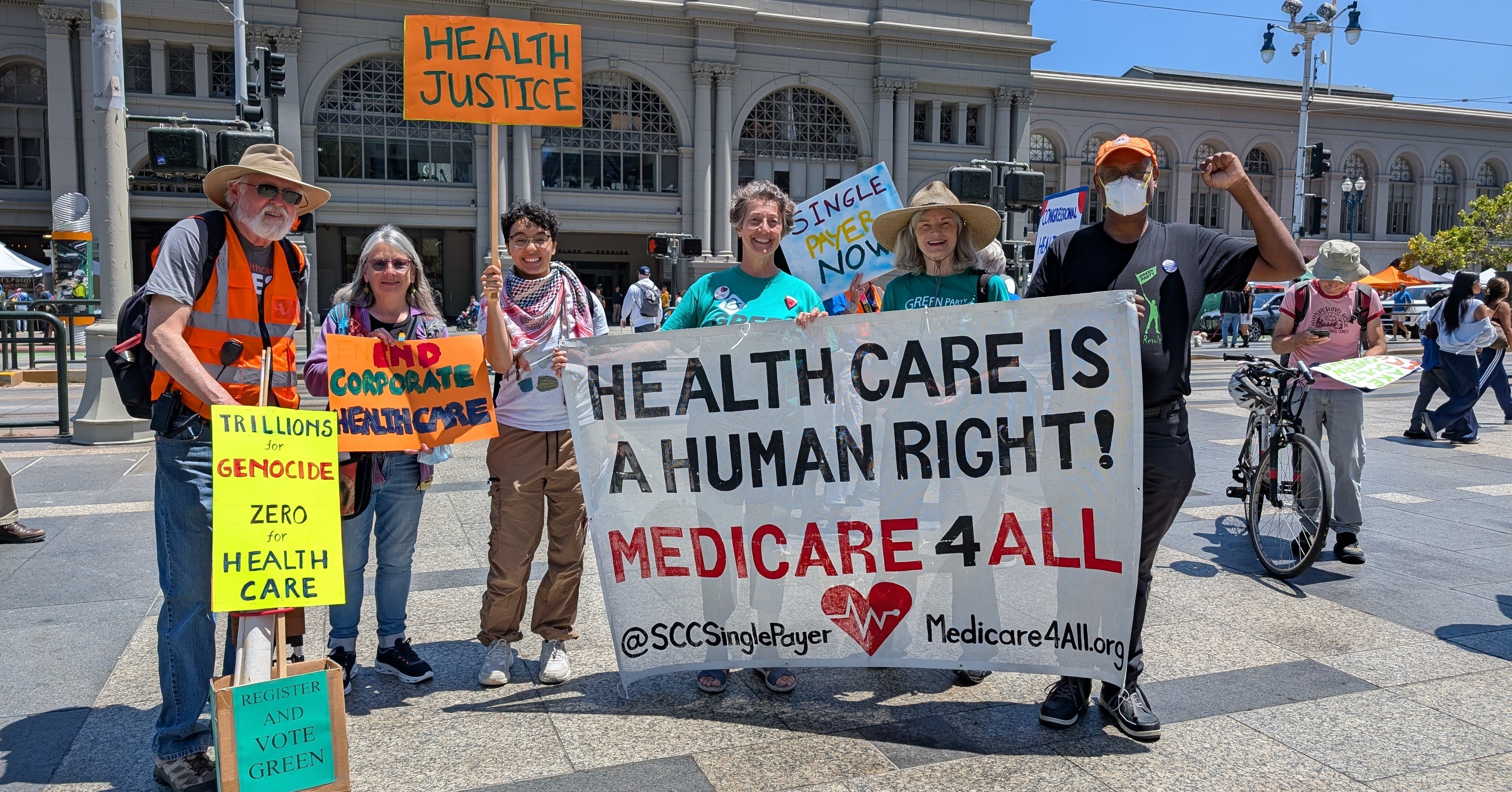
One of my organizing focuses in the Bay Area is single-payer healthcare, or what more people may refer to as Medicare for All (M4A)* or universal healthcare. It is defined as health insurance for everyone, regardless of age, employment status, or pre-existing conditions, paid for by the government (the “single payer”).
I remain convinced that the public is open to single-payer healthcare now more than ever. Senator Bernie Sanders helped popularize the idea of Medicare for All, particularly during his 2020 Presidential campaign, which forced all the other Democratic candidates running for the nomination to have their own M4A proposals or at least discuss it. There was a once-in-a-lifetime pandemic via COVID-19 in 2020 as well, which has majorly increased awareness of the inherent brokenness of the U.S. healthcare system.
And perhaps most infamously, across the political spectrum, people sympathized with The Claims Adjuster, the moniker given to the person who murdered United Healthcare CEO Brian Thompson in December 2024. Luigi Mangione, the person currently accused of perpetrating the crime and facing three different trials in different jurisdictions, has also been defended by the public. The public broadly agreed that private health insurance has harmed and killed people on a massive scale.
The murder of the United Healthcare CEO prompted me to learn more about the movement for single-payer healthcare, and how we could redirect the energy of Mangione’s sensational trials towards long-term organizing.
I am also privileged to have access to the healthcare industry in several ways. First, I am a materials scientist in the pharmaceuticals and biotechnology industry. I am passionate that drug development be made public, instead of the current crapshoot for venture capitalists that lead to recurring lay-offs of thousands of workers every few years.
Second, my wife is a medical student at the University of California, San Francisco (UCSF). We are lucky to live just a short walk away from multiple hospitals and top-tier medical facilities. This means access to not just current medical students, but residents, attending physicians, nurses, pharmacists, and more.
With the same ethos as Solidarity Now, we are hoping to increase collaboration with like-minded groups and pool our resources to execute effective actions. Those groups include:
National Single Payer, a non-profit organization founded by several physicians and experienced healthcare organizers.
Students for a National Health Program (SNaHP), the medical student counterpart of Physicians for a National Health Program (PNHP).
Democratic Socialists of America (DSA), a large political organization largely dedicated to reforming the Democratic Party. While we at Solidarity Now are critical of the reformist approach of DSA, we also think there is significant potential to utilize their resources and large membership, especially after the Zohran Mamdani campaign. The organization itself is also moving further to the left, as evidenced by the 2025 DSA national convention and the rise of communist factions into local DSA leadership positions.
The Green Party (US), a long-established third party in the United States that has universal healthcare as a core principle.
I will be providing updates for National Single Payer and Students for a National Health Program (SNaHP), as there has been the most activity between those organizations. Thoughts on future strategy for collaborating with DSA and the Green Party will also be mentioned.
National Single Payer Updates
Within National Single Payer, the recent strategy has been focusing on national days of action. There were two days of action in summer 2025: May 31st and July 30th. The May 31st rally, titled Demand Health! Not Profit, had many sponsors and broader participation across the country. The July 30th rally was smaller, and intended to celebrate the 60th “birthday” of Medicare and Medicaid.
I participated in both days of action and was discouraged to find that turnout was not high, particularly for the July 30th rally. The demographic was also rather narrow, and consisted almost entirely of people above age 55. There are a few factors behind this, the most obvious being that people currently on Medicare are acutely aware of its shortcomings and will immediately feel the impact of cuts to Medicare. I also think the days of action were not scheduled at convenient times for average working people; they were often in the middle of the day. Finally, the outreach was done primarily via email and local news outlets, which misses major demographics that rely on social media to get their information.
Prior to the July 30th rally, I suggested that we offer some sort of long-term, recurring event such as monthly virtual teach-ins that could get people connected to the movement. People were very receptive to this idea. We began organizing the first teach-in for the end of September 2025, and advertised it at the July 30th rally.
Senior and Disability Action was kind enough to sponsor our teach-ins, providing a snazzy registration page and live Spanish interpretation during the September teach-in, which significantly expanded our reach. There were several monolingual Spanish speakers that attended. At its height, we had slightly less than 30 people in the Zoom call.
The first teach-in was just focused on making the case for national single payer, and why our healthcare system is far from normal. Dr. Ana Malinow, a Steering Committee member of National Single Payer, gave a fantastic presentation in under 20 minutes that made a convincing case for the layperson. I proceeded to give a 15-minute presentation on the principles of mass movement organizing.
The second teach-in, held on October 30th, focused on exchange healthcare insurance subsidies. Dr. Malinow again gave a very clear presentation on what exactly those are, which are essentially subsidies given to private health insurance companies participating in the Affordable Care Act (ACA, or Obamacare). It is a key issue in the current federal government shutdown, and is causing panic as the expiration of the subsidies is causing ACA premiums to shoot up by thousands of dollars.
I gave a short presentation on calculating a “win” number for the National Single Payer movement, and how we can apply principles of electoral campaign organizing to a mass movement. While the “win” number is still quite large—anywhere in the ballpark of 11 to 13 million people, depending on your method of calculation—it only requires targeting a few states instead of all 50 states. I also motivated identifying strong bases of support via polling data, and targeting our organizing there to maximize momentum and growth.
Compared to the first teach-in, we had slightly over 30 attendees. Something we had asked of participants in September was to bring a friend to the October teach-in. It’s unclear how many people did this, but the slate of attendees appeared significantly different from the first teach-in. We unfortunately did not have live Spanish interpretation for the October teach-in, so there did not appear to be any monolingual Spanish speakers. I will attempt to motivate having this be a staple in our future teach-ins if the resources are available.
Our next teach-in is slated for December 2025, and I plan on talking about setting actionable timelines for growing the single payer movement, as an extension of the “win” number presentation. I also want the teach-in to be more open to participants’ ideas about organizing and how to best engage the public.
Action items include:
I am going to suggest we facilitate another national day of action with a better outreach strategy sometime in February or March, at a time that most workers can make. I think it would also be ideal to have participation from medical students around the country (see next section on SNaHP updates).
I also think it’ll be key to follow developments in the Luigi Mangione case, and use those news items to connect people to our organizing.
In general, we ought to start a propaganda campaign that emphasizes the evil nature of private health insurance companies to continue to build public support for our cause.
Finally, I am hoping to do more canvassing at hospitals and medical facilities nearby, to get as many patients and healthcare workers onboard as possible.
Students for a National Health Plan (SNaHP) Updates
As mentioned previously, my wife is a medical student at UCSF. She has re-established the SNaHP chapter at UCSF as of a few months ago, which had become inactive for the past few years.
On October 20, 2025, SNaHP at UCSF held their first in-person event open to other students. It was a lunchtime talk (free lunch being a key marketing strategy) focused on comparing the U.S. healthcare systems to those of other countries, given by Sophie. Sophie is a first-year medical student at UCSF, an officer of the UCSF SNaHP chapter, and a member of DSA. Space for discussion was given after the presentation.
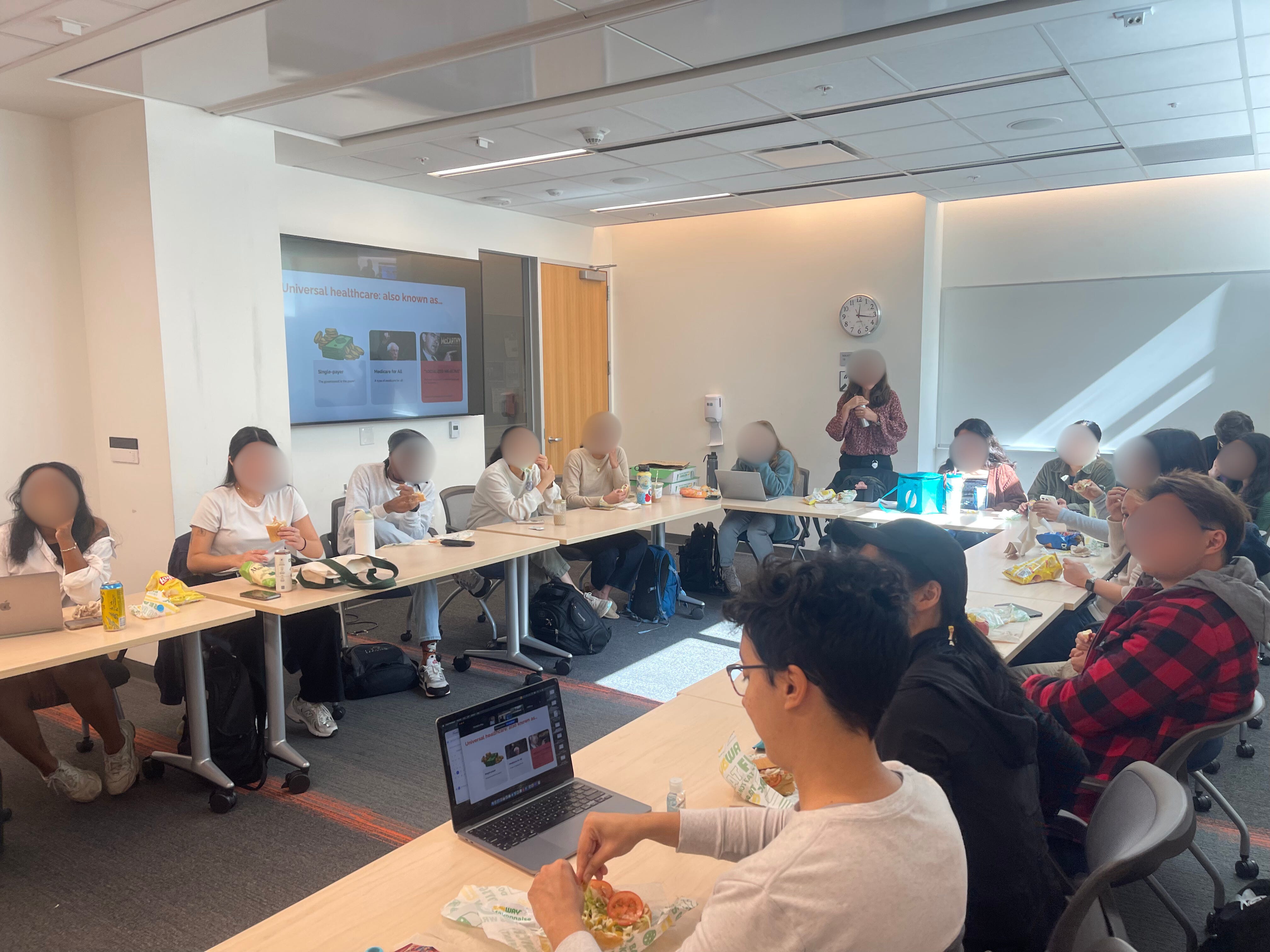
The turnout was solid, with approximately 15 engaged attendees. SNaHP at UCSF was kind enough to allow me to take part in the discussion and provide political insight for mass movement building. Great questions were asked about the feasibility of outlawing private insurance, as well as whether or not we should aim for a more incremental solution, such as slowly increasing public healthcare coverage by age groups over time.
I believe we made the case for national single payer quite well, and that it was received well by the medical students. SNaHP plans on hosting future lunchtime talks that will hopefully feature a larger turnout and more robust discussions. To ensure crossover between organizations, we intend on inviting Dr. Ana Malinow from National Single Payer to give a talk with some sort of ask to get students further involved.
My wife has also gotten into contact with other SNaHP chapters at other medical schools in California, and there is interest in building a statewide coalition of SNaHP chapters. I think this could be incredibly powerful if medical students leverage their status and visibility to make a very public statement about national single payer; I imagine it could be significantly disruptive, similar to the encampments college students made to protest on behalf of Palestine. However, I think a key disconnect in the national single payer movement is that people don’t often see their own doctors and nurses advocating for it. Doctors (including medical students) ought to be using their political authority and status to broaden the political imagination of the average American.
Action items include:
We will be coordinating a SNaHP-sponsored lunchtime talk with Dr. Ana Malinow or another representative of National Single Payer in the near future.
Hosting a lunchtime talk or event that features a relevant healthcare workers union, such as the California Nurses Association (CNA) or National Union of Healthcare Workers (NUHW). We want to discuss recent labor actions such as the recent Kaiser strike that had AI replacing nurses as a key complaint, or the UC Benioff Oakland strike that was attempting to protect free healthcare for its workers. We want to use this to begin to connect organized labor to the movement, particularly rank-and-file members.
Coordinating actions with the California coalition of SNaHP chapters. Pushing for a national coalition and coordinate similar future actions.
A long-term goal of UCSF SNaHP is ensuring the core curriculum covers health insurance and the need for a single-payer system. Shamefully, most medical students learn nothing about health insurance.
Thoughts on Strategy for Democratic Socialists of America & the Green Party
As mentioned in the last section, Sophie is a member of DSA. She has significant experience in organizing for single payer when she lived in New York. She is interested in re-starting a healthcare working group in the SF chapter of DSA. I intend on assisting with this effort and joining DSA to do so.
While DSA has reformist tendencies, it has significant resources (especially compared to the rest of the American left) that ought to be leveraged in building a mass movement. I’m especially interested in collaborating on outreach, and folding in as many locals as possible for future actions sponsored by National Single Payer or SNaHP.
I am also a County Council member of the San Francisco Green Party. I will be participating in a statewide meeting of Greens in mid-November and will attempt to submit a proposal to make national single payer a priority campaign for the Green Party. Unfortunately, the Greens do not have many resources and their membership levels are low. However, making national single payer a “Green” issue would go a long way in making the point that only third parties will be successful in winning this fight.
Thank you for reading, and if you liked our reporting, please subscribe to our Substack for similar articles. If you are interested in coming to one of our meetings at Solidarity Now, or getting involved in any aspect of this organizing, please e-mail us at organize@solidaritynow.info
*There are a few differences between a true single-payer healthcare system and Medicare for All (based on current bills sitting inactive in Congress, such as Rep. Jayapal’s (D-WA) Improved Medicare for All bill, H.R. 3069). For example, under a true single-payer system, private health insurance and private ownership of healthcare facilities would be illegal. Rep. Jayapal’s bill still allows for the private ownership of healthcare facilities.